Flying to Tenerife: PRO Tips from the Airport to Landing
2026. Oktober 31., Samstag, 09:03
How do you get to Tenerife, and what should you expect at the airport and on board? In this guide we walk through a scheduled flight from A to Z: getting to the airport, check-in, baggage rules, security and boarding, all the way to turbulence and arriving in Tenerife, with plenty of PRO tips that can save you time, money and stress.
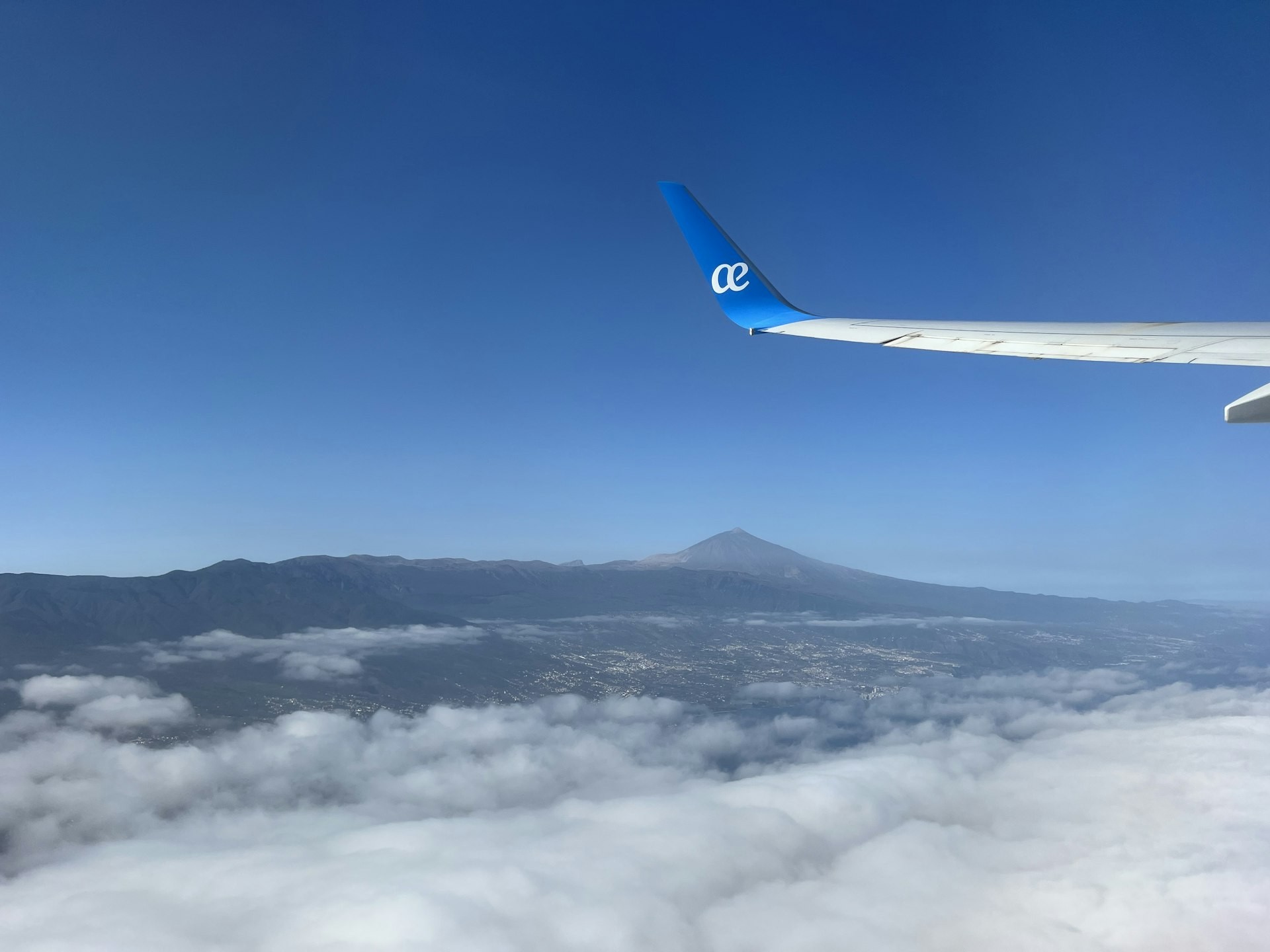
Teide seen from the plane window, above the clouds, on the approach to Tenerife. On a clear day you can see the volcano from far away, so if you have a window seat, keep your phone ready.⏐Fotó: Unsplash, Till Butzke
Private jet or scheduled flight?
There are two ways to fly to Tenerife. One is by private jet: both the northern (TFN) and southern (TFS) airports accept private aircraft, subject to the usual airport procedures and permissions. Most people, of course, arrive on a scheduled flight, and that's what this guide covers from A to Z. For more about the island's airports and Tenerife in general, read Tenerife as a Destination: Everything You Need to Know.
Why fly direct?
Direct flights, including low-cost ones, run to Tenerife from many major European cities, and you can reach the island with a connection from most international airports. We recommend flying direct, especially for a shorter holiday. The problem with connections is that you usually arrive exhausted: you either leave ridiculously early, arrive ridiculously late, or somehow manage both. In practice you lose most of a day to tiredness. For a big family, saving money with a connection can make sense, but for 2–4 adults a direct flight is almost always the better choice.
Getting to the airport
Public transport: usually a bus or train.
A lift: someone drives you in your car or theirs.
A private transfer or a taxi, if you live close enough.
Your own car, parked at or near the airport.
The last one is especially practical: when you land back home, even at some beautifully antisocial hour, you simply get in your car and drive home, instead of starting a second expedition just to reach your front door.
What to wear and what to prepare
Fly in sneakers. Airlines recommend comfortable footwear too, and in an emergency proper shoes are much safer than stumbling around in heels like a newborn giraffe.
Wear your heavier clothes on the plane; that's a few kilos (pounds) your suitcase doesn't have to carry. Bring a sweater and a light summer scarf as well: you may spend several hours under the air conditioning, and even if you close the vent above your head, cold air still has an impressive ability to find your chest. We've seen it countless times: people land in Tenerife with a cold and start their holiday sneezing. That part is no joke. (A sweater comes in handy on the island too, as we explain in our article on Tenerife's weather.)
Before you travel, scan your travel documents (ID card, passport and anything else important) and save the copies on your phone for offline use, and preferably in the cloud too. They're also useful when you head to an activity where you need to show ID.
Download the Flightradar24 app as well: it covers virtually every airport in the world and lets you track flights in real time, so you can see delays, estimated landing times and what is actually happening with your aircraft.
Very important: a delayed flight doesn't mean you can arrive late at the airport. If you see your flight is, say, 2 hours late, don't leave home 2 hours later! Your check-in and bag drop deadlines stay exactly the same, because bag drop closes at a fixed time. At worst, you'll spend the extra time in duty-free after security, examining perfume, alcohol and Belgian chocolates you had no intention of buying.
When to be at the airport
With checked baggage: in our experience, be completely ready at the terminal entrance 2.5 hours before departure. And we mean actually standing there: not still parking the car, not just getting out of a taxi, and not wondering whether you unplugged the iron.
With hand or cabin luggage only: you don't need the check-in desk, just security. In that case, being at the terminal 1.5 hours before departure is enough.
Check-in and checked baggage
As you enter the terminal, you'll see large screens showing the check-in desk numbers for your flight. Find the matching numbers hanging from the ceiling, walk over, join the queue and drop off your bag.
PRO tip on weight: many airlines offer 20 kg (44 lb) as the standard checked bag, but we recommend 23 or 26 kg (51 or 57 lb) instead. In our experience, most people somehow end up above 21–22 kg (46–48 lb) anyway, because suitcases tend to gain weight during holidays, right alongside you. Every extra kilogram you pay for at the airport as excess baggage usually costs more than buying the higher allowance online in advance.
PRO tip on spotting your bag: put a luggage tag on your checked bag with your full name, phone number and email address, and tie on a brightly colored ribbon or another obvious marker. Most suitcases look alike, and it does happen that someone grabs yours at arrivals and only notices the swap at the hotel. It has happened to us too.
Sports equipment
You can also check in sports equipment: a SUP, a surfboard, a bicycle, a fishing rod or other gear, as long as there's no engine inside. There's usually an extra fee, and it's your responsibility to pack everything properly. Airlines don't always give one universal size limit, but you obviously can't check in a Tiger tank or strap it to the roof of the plane with bungee cords. As a rough guide, keep it within about 4–5 m (13–16 ft).
Duty-free allowances on the way home
The Canary Islands are outside the EU VAT and excise area, so when you fly home from Tenerife to another EU country, these standard duty-free allowances apply per adult:
Cigarettes: up to 200, which is basically one carton.
Spirits: 1 L (33.8 fl oz) over 22%, or 2 L (67.6 fl oz) at 22% or below.
Wine: 4 L (135 fl oz) of still wine.
Beer: 16 L (541 fl oz).
Anything above these limits may be subject to duties and taxes. If you're flying home to a country outside the EU, such as the UK, your own country's allowances apply. One important detail: travelers under 17 don't get an alcohol or tobacco allowance, so unfortunately your 10-year-old daughter can't be used as extra customs capacity.
Hand and cabin luggage
There are two main types. Personal hand luggage can be a handbag, shoulder bag, tote bag, sports bag or backpack. Cabin baggage usually means a small rolling suitcase.
Liquids are limited to 1 L (33.8 fl oz) in total, in containers of no more than 100 ml (3.4 fl oz) each, and that includes toothpaste and perfume. Medicines and baby food are treated separately. Put your liquids in a resealable transparent bag and take it out at security, where your perfume briefly becomes a matter of national interest.
3 PRO tips for your bags
Four-wheel suitcases: choose one whenever you can, especially when you're pulling 10–26 kg (22–57 lb). Your spine will notice the difference.
Your own sandwiches: you can bring them on board, so there's no need to spend your retirement savings on a cheese roll.
Valuables in your hand luggage: checked bags do occasionally disappear; it has happened to us and to people we know. Keep anything truly important with you: valuables, and especially any medication you may need on the day you arrive. Unless, of course, your priceless family heirloom is a samurai sword, in which case it has to go in the hold.
Security
If you only have hand or cabin luggage, this is your first stop; if you checked a bag, it comes after check-in. Depending on the airport, you may need to take out electronics (phone, laptop, tablet, smartwatch, power bank) and put them in a separate tray. Belts usually have to come off, suspenders can stay on, and ordinary sneakers are usually fine. Elegant leather shoes, on the other hand, may have to go in the tray, leaving you to cross security on your little paws. Empty your pockets completely.
If you're pulled aside for extra screening, don't panic. We've been pulled aside at several airports ourselves, and it has always just been a more thorough check. They're mainly looking for dangerous items, not trying to ruin your holiday.
Duty-free and water
Duty-free looks tempting because you expect everything to be cheaper. With Tenerife, that's not always the case: in our experience, shops found all over the south, such as Spanish Style, often sell alcohol and tobacco cheaper than airport duty-free. So we'd mainly use duty-free for a last-minute gift.
What we do recommend buying is mineral water. Flying dehydrates you surprisingly fast, so take at least 1 L (33.8 fl oz) per person on board. You'll usually find 1 L bottles at newsstands, while duty-free shops tend to play the 0.5 L game.
And if flying, together with the knowledge that you haven't booked your activities in advance on FINESTPASS™, makes you nervous and you're tempted to start drinking: most airlines don't let you drink your own duty-free alcohol on board. You can buy drinks from the crew instead, at prices normally associated with legal representation.
Mit der Seilbahn bis zur Bergstation (3.555 m / 11.663 ft), danach mit einem lokalen Guide weiter zum Gipfel des Teide (3.715 m / 12.188 ft) - dem höchsten Punkt Spaniens. Das vollständigste Vulkanerlebnis auf Teneriffa.
Ein Wasserpark im thailändischen Stil, der zum besten der Welt gewählt wurde mit 3 Meter hohen künstlichen Wellen, spektakulären Kinder- und Familienbereichen sowie Attraktionen, die vom ruhigen Strömungskanal bis zum 28 Meter hohen freien Fall reichen.
Once you're through duty-free, look up at the screens again: this time you need your gate number. Then just follow the signs. It's that simple, apart from the fact that your flight always seems to leave from the furthest possible gate. There are always restrooms nearby, so you can go before boarding.
When it comes to boarding, there are two sensible strategies:
As early as possible: you're much more likely to find space for your bag in the overhead bin right above your seat. The downside is that you may spend 30–45 minutes standing in line before you even get on the plane.
As late as possible: you sit and wait, and when only 3 or 4 people are left, you casually stroll over like the head of an Italian mafia family and join the end of the line. The downside is that the bin above your seat may already be full, unless you've booked the first row, where the overhead space is usually kept for those seats.
If flying makes you nervous
If flying (or the fact that you still haven't booked your activities in advance) makes you nervous, you have a few options: breathing exercises from the moment you arrive at the airport until takeoff; a drink to calm your nerves; or a sedative prescribed for you, which we wouldn't recommend casually. The key point: don't combine them. One coping mechanism is enough.
During takeoff, chew gum or keep your mouth slightly open to stop your ears from blocking.
Turbulence: unpleasant, but normal
Turbulence is irregular movement in the air that makes the aircraft shake, bounce or occasionally drop a little. It can feel horrible, but aircraft are designed to cope with forces far beyond anything you normally experience as a passenger. Airliners go through enormous structural tests before they enter service: Airbus, for example, physically bends the wings under extreme loads to prove the structure can take it. So when the cabin starts shaking, the aircraft is having a much less emotional experience than you are.
Turbulence is usually classified into 4 levels:
Light: basically just annoying.
Moderate: your orange juice leaves the tray without consulting you.
Severe: loose objects get thrown around and you're pushed hard against your seat belt.
Extreme: genuinely violent, but exceptionally rare.
One of the more unpleasant kinds is clear-air turbulence (CAT). It can occur in apparently clear weather, doesn't show up on conventional weather radar, and often comes with very little warning. That's why we recommend that you always keep your seat belt fastened while seated, except when you go to the toilet or get up to stretch. Don't keep a laptop or tablet loose on your lap, don't leave the tray table down unnecessarily, and stow loose items away. In strong turbulence, these become surprisingly effective projectiles, and the aircraft may be perfectly fine while your head punches a hole in the ceiling.
Diversions and unscheduled landings
Sometimes a plane lands somewhere other than where it was headed. It has happened to us too. There's usually no reason to panic: it's often caused by weather, or because the destination airport temporarily can't receive the aircraft. Depending on the situation, this can mean a delay of roughly 2 to 12 hours. Technical issues can also lead to an unscheduled landing, but that doesn't automatically mean something catastrophic is happening: crews are rather conservative about keeping everyone safe.
On board: space, toilets, shopping and food
A common question is whether you'll feel claustrophobic on the plane. In practice, most people don't: the cabin feels surprisingly open, and after a while your brain barely notices that you're sealed inside a metal tube at 10,000 m (32,800 ft).
PRO tip: on most Boeing and Airbus aircraft flying to Tenerife, you'll find toilets at the front and at the back. If you need more than a quick visit, head to the back: spending 20 minutes behind the front door can feel surprisingly public when 230 passengers are tracking your return. At the back, you can deal with the situation with a little more dignity and considerably less audience participation. And don't panic when you flush: the noise sounds powerful enough to cut threads into your eardrums.
You can also shop on board: perfumes, watches and the usual airborne range. Prices aren't terrible, but they're not exactly a financial miracle either. Food and drinks cost more, which is understandable given they're served several thousand meters up. On flights to Tenerife you can usually buy a hot meal too, and while you shouldn't expect a gourmet stew, the food is surprisingly decent.
Alcohol on board: one or two drinks
Some people drink themselves into an orangutan on the plane. In our experience, once you go beyond one or two drinks, whether long drinks, shots, beer or wine, there's a good chance you'll land with a headache, which can ruin the rest of the day or even the next morning. And if someone really overdoes it and turns disruptive, the plane may even divert, and the holiday starts at the police station. So: one, or at most two drinks.
Keep moving to prevent blood clots
On longer flights, sitting still for hours can increase the risk of blood clots, especially in people who already have other risk factors. The advice is simple: once the seat belt sign is off, stand up occasionally, walk a little, and move your ankles and calves while seated. Aim to get up roughly every hour, rather than spending the whole flight folded into one position like abandoned garden furniture.
If you know you're at higher risk of blood clots, talk to your doctor before you travel. Graduated compression socks may be recommended for some people (we sometimes wear them ourselves): put them on before the flight, wear them correctly, and follow the medical advice that applies to you. The main point: keep your legs moving, stay hydrated, and don't spend hours in one position.
Dry cabin air
Aircraft cabins are extremely dry: humidity is often well below 20%, and on some flights around 10% or even lower. If you have sensitive skin, face cream, hand cream or another moisturizer can help. Fly without, and you may get off the plane looking like a prune that's been left in the sun for two weeks.
Time difference
The times on your ticket and boarding pass are always in local time: departure in the time zone you're leaving from, arrival in the time zone of your destination. Tenerife is one hour behind Central European Time (the same time as the UK, Ireland and Portugal). So when it's 21:00 (9 PM) in Berlin or Budapest, it's 20:00 (8 PM) in Tenerife. If your ticket says you land at 15:50 (3:50 PM), your phone may still show 16:50 (4:50 PM) in the air until it switches to local time after landing.
Applause and the cockpit
Clapping after landing can drive experienced travelers mad, but after talking to quite a few pilots, we can tell you that many of them actually appreciate it. And honestly, who doesn't like their work being acknowledged?
Since 2001, cockpit access has understandably become a very sensitive subject, so never just ask to go in. If you're traveling with a child, though, it can be worth politely asking a flight attendant after landing whether the pilots might let the little one take a look. They're often very kind about it, once they've established that the child isn't basically the Tasmanian Devil. For adults, this almost never works.
Arriving at Tenerife South Airport
After landing, there are three ways into the terminal: on foot from the aircraft, by a short bus ride, or straight in through a jet bridge. Tenerife South Airport (TFS) is relatively small, so getting from the plane to baggage claim usually takes only 5–10 minutes.
Passport control: if you're arriving from the Schengen Area, there's normally none, and you can go straight to baggage claim. Arriving from outside Schengen, you'll pass border control first, which may take a little longer.
Checked baggage: usually arrives on one of the carousels within 10–15 minutes. This is where that colored ribbon becomes a work of genius; otherwise you may spend 10 minutes studying 40 identical black suitcases like a police lineup. There are restrooms near the carousels, so you can use the wait productively.
Car hire: if you rented from CICAR, their desk is in the baggage hall, so you can collect your car while your suitcase makes its ceremonial entrance. The other rental companies' desks are in the main terminal: collect your luggage, walk out and turn left, and they're only about 30–60 m (100–200 ft) away.
Bus: walk straight out of the terminal and you'll find the bus stops right in front of you. Tenerife has no trains, so buses do the heavy lifting.
Taxi: as you leave the terminal, keep to the right, where the taxi rank is.
There's a duty-free shop on arrival too, but we wouldn't buy much there either: you'll usually find the same things cheaper later in shops such as Spanish Style. So unless you urgently need perfume within six minutes of landing, keep walking.
Plan ahead
So flying to Tenerife isn't complicated; it just pays to be prepared. The same goes for activities: popular experiences and the best time slots often sell out before you arrive. With FINESTPASS™, our local team recommends tried-and-tested tours and activities that you can book securely from home. For more detail, download our free digital travel guides.
Eine von elementarem Flamencotanz, Farben, Live-Gitarre, Gesang und Kraft erfüllte Aufführung, die von dem renommierten Flamencotänzer Fran Chafino kreiert und inszeniert wurde.
Der als bester Zoo der Welt geltende Loro Parque ist kein gewöhnlicher Zoo: Er vereint mehr als 400 Tierarten, einen mit echtem Schnee gestalteten antarktischen Lebensraum, das größte Korallenriff außerhalb des Ozeans und weltberühmte Tierpräsentationen zu einem einzigartigen ganztägigen Erlebnis.
 de


 Teide-Nationalpark